GIS Lab
|
|
|
|
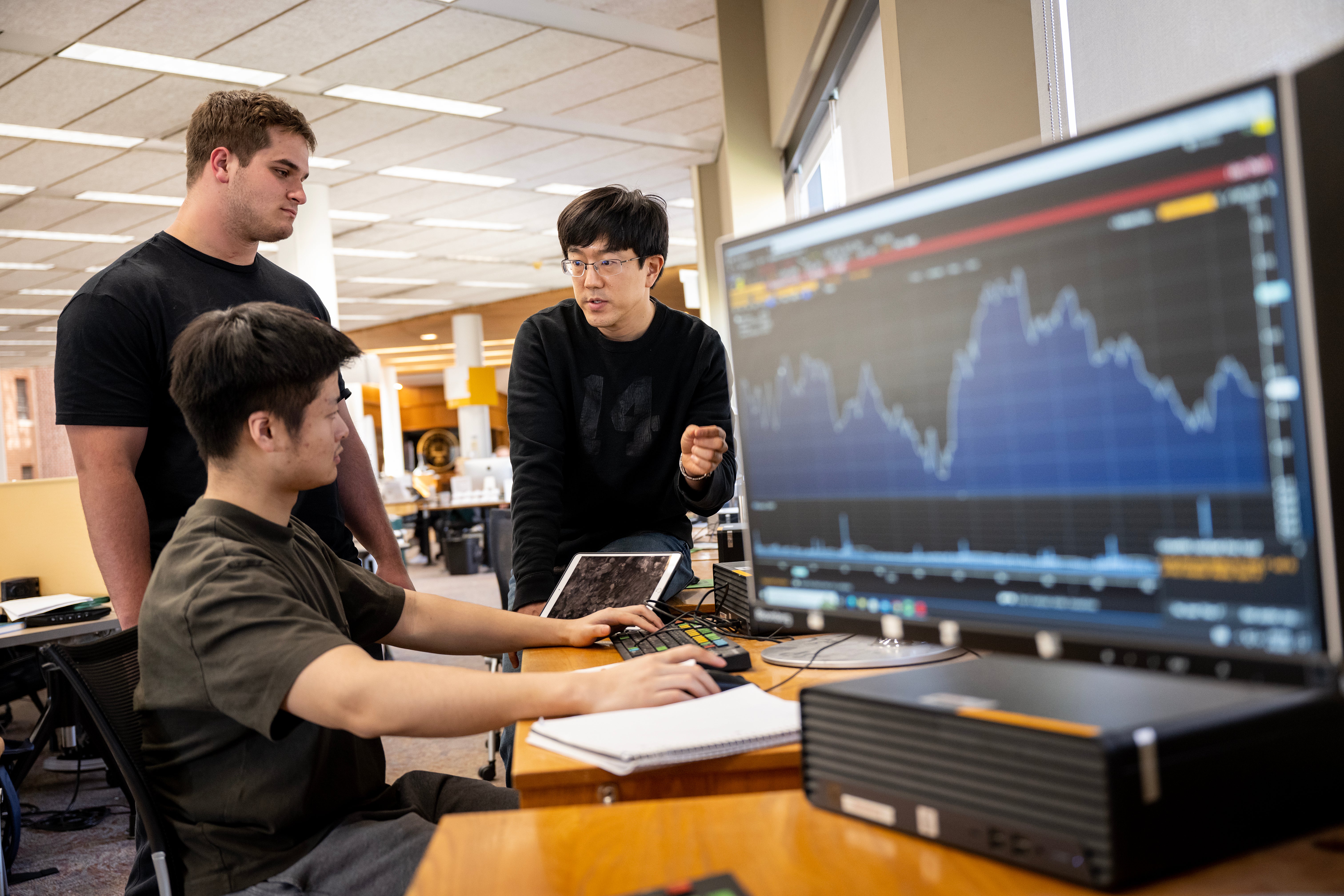
The Environmental Studies Program has established a high end Geographic Information Systems (GIS) laboratory in Barney-Davis Hall. We have invested more than $150,000 in our lab, thanks to the generosity of the Bingham Foundation and the Denison administration.
The lab is equipped with 16 Dell workstations with flat screen monitors, a large-format digitizing tablet (used to convert large hard copy maps into digital form), a production-quality HP DesignJet 455CA color plotter, a high resolution Epson Stylus Photo 1280 color inkjet printer, a black-and-white HP LaserJet printer, Garmin GPS units, and a Sharp LCD projector linked to a teaching computer for heads-up instruction. GIS and ecosystem modeling software used in the lab includes the full suite of ESRI ArcGIS, IDRISI, and STELLA.
GIS allows maps to be rendered in digital form and used for various kinds of record keeping and analysis. Though people do not conventionally think of issues this way, almost any conflict or environmental issue can be examined from a geographic point of view it is almost always about a place, locally or regionally defined. GIS allows the user to establish multiple map layers about that place, combine these base layers through overlay analyses to create "new" layers, and then examine the integrated data for common patterns that might be useful in improving a situation. So, for instance, GIS is increasingly used in projecting development patterns in rural and suburban areas. With map layers of roads, soils, hydrology, existing land uses, zoning regulations, and other features of the landscape, a plan can be established that gives greater priority to agricultural land preservation than a non-GIS-based analysis might create. GIS is used to establish buffer zones for endangered species, models of pollution flow from oil spills, and intergovernmental control of protected harbors. It allows testing of scenarios that are typically impossible otherwise, given the number of spatial parameters and unique combinations of features.
GIS is probably the single most important advancement in environmental analysis over the past twenty years, and this technology is already transforming the opportunities for research, career paths, and policy initiatives worldwide. The sooner future environmental professionals can be introduced to this critical innovation, the better success we can expect in solving environmental problems. Denison is well positioned to be a leader in providing these skills.
Denison currently offers two courses in GIS, Introduction to Environmental Mapping and Advanced GIS. Students learn to create a GIS database from scratch, using hardcopy maps and aerial photos as well as satellite imagery and digital databases, such as those available from government agencies like the US Geological Survey. Once created, these databases are used in sophisticated suitability models for real-world applications in the local community. Along the way, students learn the importance of metadata, scale, accuracy, precision, and projections and coordinate/reference systems in a GIS analysis, in addition to acquiring skills such as digitizing, editing, resampling, and database management (integrating tabular attributes, such as names of buildings, species of trees, widths of roads, etc.). Many students from these classes are qualified to make full use of GIS in careers and graduate programs, and their qualifications are already superior to the majority of undergraduates seeking employment and continued study in the environmental arena.
GIS is certainly not the singular focus of Environmental Studies, and ES majors are not required to gain expertise in this technology. But acquiring this advanced GIS technology has allowed us to foster innovative interdisciplinary education that gives Denison students, faculty and the local community some tremendously powerful opportunities that are rarely available in the realm of liberal arts education.