



Student, Professor Making Waves with Collaborative Video Game Study
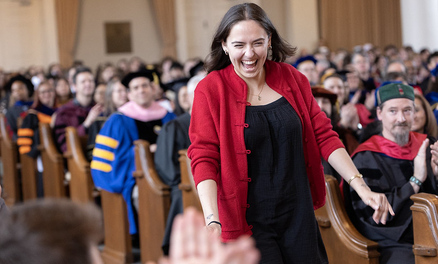
Brittany Cerankosky '08, who ran cross-country during her Denison days, has co-authored a forthcoming article in Psychological Science with Associate Professor Robert Weis.
By Natalie Olivo '13
A forthcoming publication once again has Denison’s psychology department at the forefront of research in the field.
Associate Professor Robert Weis and Brittany Cerankosky, who graduated from Denison in 2008, will be publishing “Effects of Video-Game Ownership on Young Boys’ Academic and Behavioral Functioning” in Psychological Science. The article, which was made available online to subscribers in February, represents the culmination of years of collaboration and research that began in Denison’s Summer Scholar Program.
The study, which already is receiving international attention, offers experimental evidence that video games "may displace after-school activities that have educational value and may interfere with the development of reading and writing skills in some children."
Professor Harry Heft, a colleague of Weis and Cerankosky in the psychology department, hailed their research, calling it “especially impressive” because the pair “went beyond merely looking at psychological outcomes, such as academic performance, and examined ways that this technology alters how children spend their time across a wide range of activities.”
During her sophomore year at Denison, Cerankosky decided to collaborate with Weis after taking two classes with him and discovering that his professional interests in childhood development aligned with her career aspirations in pediatric psychiatry.
After getting the green light from Weis, Cerankosky began exploring the existing literature on video games and children’s behavior. While writing a 75-page thesis, she drew upon many of the research skills that she learned in her psychology classes, including recruiting subjects and designing experiments.
She began her empirical study in the Summer Scholars program and continued the project through two semesters of senior research. She said of her faculty collaborator: “Weis made it a full-fledged respectable study with his dedication and professional finesse.”
Their research team followed 64 boys, aged six to nine, over the course of four months. The two found that boys who received a PlayStation as part of the experiment demonstrated significantly lower reading and writing scores than those who did not. Interestingly enough, the PlayStation seemingly had no effect on the boys’ math and problem solving skills.
Cerankosky emphasized that “there isn’t necessarily something inherent in video games that negatively affects kids; it’s an activity that detracts from time that could be spent on schoolwork.” “The kids in our study could have been reading Stephen Hawking, and we might have found similar results,” she noted.
Such strides in the study of child behavior stemmed from Cerankosky and Weis’ taking their research to the experimentation level. All previous studies on the subject of video games were based primarily on observations of correlation. According to Heft, “this additional step [of experimentation] allows psychologists to move beyond simple claims about positive or negative effects to offer a richer picture of the place of this technology in the lives of children.”
Since the advance release of their article, Weis and Cerankosky have been garnering accolades internationally. Specifically, their work has caught the eye of Ed Yong, an award-winning British science writer. Yong wrote about the duo’s findings in his online science journal, Not Exactly Rocket Science, noting that “there is much to like about Weis and Cerankosky’s study.”
Back at Denison, Heft likewise praised the duo, observing that “a hallmark of the educational experience at Denison has long been such intensive and meaningful student-faculty research collaborations.”
Even with all the praise, Cerankosky herself remains humble. Now a medical student in Fort Lauderdale, she remains grateful for the opportunities that her alma mater provided. She noted with a laugh, “Thanks to the powers that be at Denison that made this all possible.”