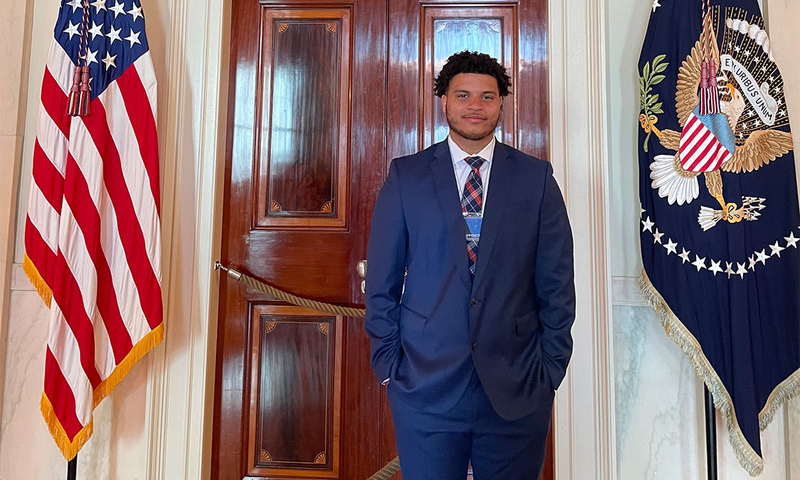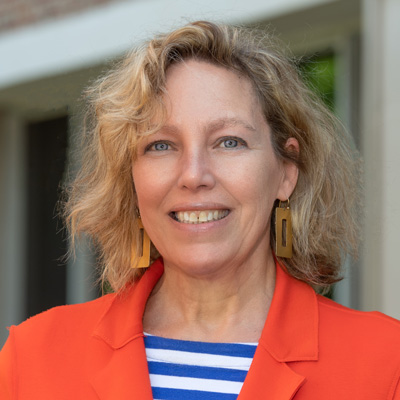


When she first came to Denison, Avery Sellers ’26 knew she was interested in education and curricular design — but she also knew she didn’t want to be a teacher.
She found her academic home in the philosophy, politics, & economics major and added a minor in educational studies. “I wanted to pursue a very liberal arts model, by looking at the intersections of knowledge,” said Sellers.
Her passion would be rewarded. A summer internship with attorney Lauren Sabo ’11 gave Sellers insight into a career path that combined both areas of study. “I had been talking with Lauren a lot about getting into the legal field,” Sellers said. “She gave me the opportunity to shadow her in her law office and to do research for her.”.
Sabo asked Sellers to investigate and identify disparities in out-of-school discipline rates in the Columbus school system. The data she accessed was based on the race and abilities of the students.
“I really loved doing that work,” said Sellers. “I discovered a lot of deeply rooted flaws in the system that we can change to directly impact people.”
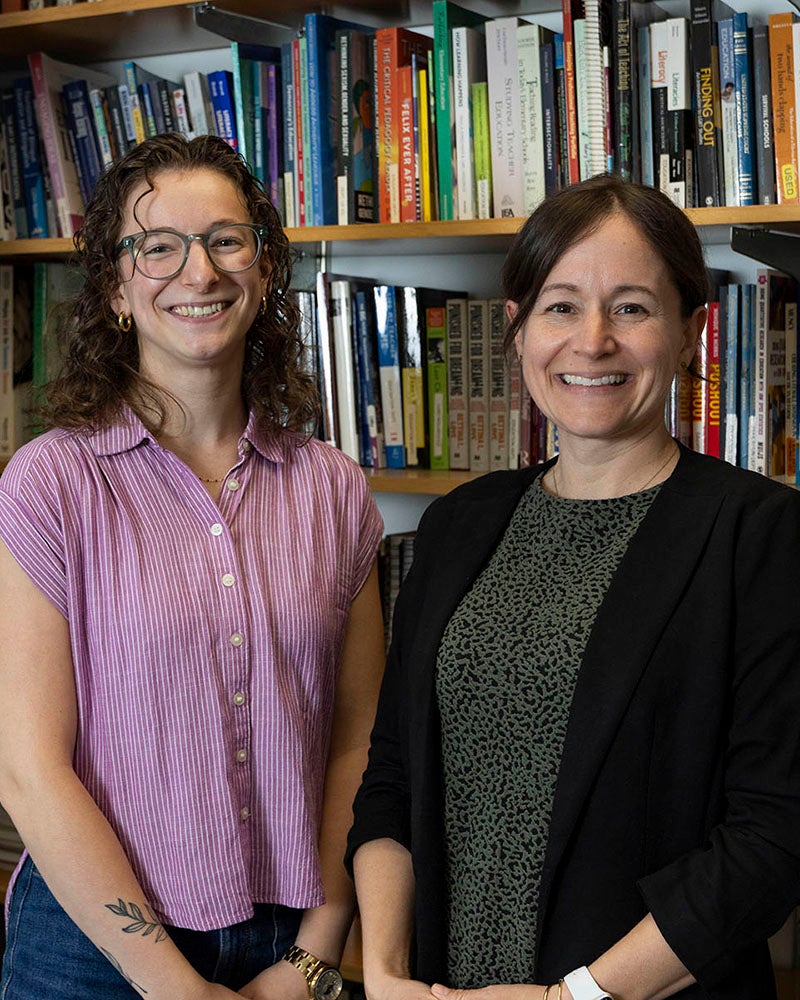
Avery Sellers ’26 with Associate Professor Emily Nemeth ’04
She brought her findings back to The Hill to develop further for her senior research project, sharing her work with Associate Professor Emily Nemeth ’04. Nemeth immediately recognized that Seller’s research would align with the focus of a new fellowship program in the educational studies department, named in honor of storied Denison alum Kirtley Mather 1909, and invited her to apply.
After graduating from Denison with a degree in geology, Mather went on to a career that ranged from mapping oil deposits and exploring mountaintops to lecturing in classrooms and providing expertise in courtrooms.
Among his many accomplishments, Mather named a previously unmapped peak for his alma mater (Mt. Denison) and taught geology at Harvard University for 30 years. He was a tireless champion of education, science, and democracy. Mather served as an expert witness for the defense in the 1925 Scopes “monkey” trial and used his elevated platform as president of the American Association for the Advancement of Science — as well as president of the American Academy of Arts and Sciences — to become one of the few public figures who spoke out against the McCarthy-era inquisitions in the 1950s.
Sellers expanded her analysis to include data points that measured the quality of democracy, and uncovered a surprisingly strong relationship between defunding public education, economic downturns, and democratic backsliding.
“I found strong economic arguments with solid numbers and tangible effects showing how defunding education creates economic, social, and political instability, which often leads to more crime, increased welfare dependency, and higher incarceration rates,” she said.
“And I saw really strong ties indicating that defunding education and backsliding democracies are both affiliated with authoritarian states,” she continued. “Before this research, I hadn’t realized there is actual empirical evidence that connects them.”
Sellers had never heard of Mather prior to her fellowship research and was fascinated to discover the parallels between her findings and his life’s work.
“He emphasized strong education for a strong democracy and did so much work to make sure everyone had access to education,” she said. “These are things I’m passionate about too.” Sellers wants to ensure that neither her work nor Mather’s legacy is forgotten. She’s writing a proposal for the Denison Community Service Association to expand community engagement and curricular service learning opportunities as components of academic coursework.
“I want to create an action component to connect departments and students through community service opportunities — something Mather emphasized throughout his life,” Sellers said.
“I want to continue his legacy of taking action in the service of education and democracy.”